
HOME / PLY · SETUP & PLAYSPACE / LOG 2026-10-14
Box room under 7.7 m²: what happens when Laser Thief thins out its stations
Below roughly 85% of 9 m², Laser Thief thins out stations but keeps every mechanic. What that means in a small room, plus a clear-the-floor checklist.
- unter 7,7 m²
- diagonal
- stehend
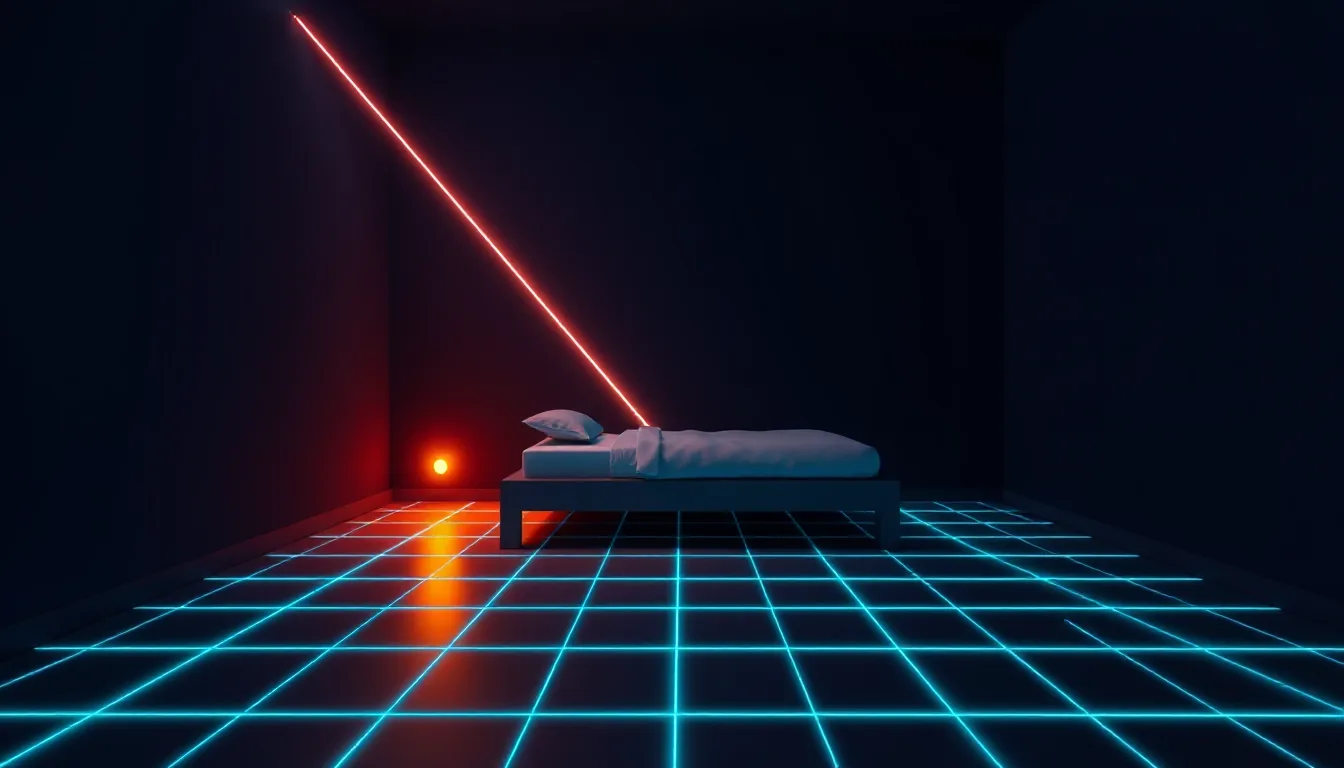
The British box room is a category all of its own: the smallest bedroom, often over the stairs, with space for a single bed and a lot of optimism. Plenty of us play in exactly that room, because it’s the only one where nobody’s watching telly. Laser Thief recommends a minimum of 3 × 3 m in the store. So the question is: what happens when your room can’t give you that?
The good news: the studio is fairly open about what the game does in small rooms. The honest news: 3 × 3 m is still the space the levels were designed for.
The number behind the headline
The levels are designed for 9 m². If your usable space falls below about 85% of that, so under roughly 7.7 m², the game switches into a small-room mode, according to the studio:
- Redundant stations get thinned out. If a level has three similar obstacles in a row, one of them can go.
- Every laser mechanic stays. A level that introduces magenta blinkers keeps its blinkers. So you don’t miss a rule.
- Squeezed gaps get widened again. Post gaps to 0.45 m, corridors to 0.5 m. The game won’t make you crawl through slots just because the room is small.
- Pad and loot move onto the diagonal. More precisely: onto the two free points that are furthest apart. In a rectangular room, that’s usually the diagonal.
After that, the solver checks, as it does for every level, that the route is doable in your room and for your height. If the check fails, a procedural layout is rerolled, or the fewest possible beams are removed along the most favourable route.
What you can realistically expect
A room of 2.5 × 2.8 m gives you 7 m². The diagonal is just under 3.75 m long. That’s more than you’d think, and that’s exactly why the game puts the pad and the loot there. So you’re not walking straight ahead but cutting across the room, and the stations spread out along that line.
What you lose is density and variety. Levels with lots of stations feel more compact, some sections shorter. In large rooms, extra laser walls are added; you don’t get those in a box room. Honestly: the full experience is on 3 × 3 m. It’s still playable smaller, because the game is deliberately built that way.
What the game doesn’t promise: that it works in any room, however small. If you’re left with barely more than a square metre after clearing the floor, Laser Thief isn’t the right game for that room.
Clear-the-floor checklist for box rooms
- The bed. The bed is usually the biggest obstacle. If it’s against the wall, you gain the floor opposite. A bed counts as furniture in the scan; the game keeps the pad and loot 0.30 m away from it.
- Desk chair out. Office chairs are the classic trip hazard. Out the door for the session.
- Laundry basket, bags, boxes gone. Anything standing on the floor eats into your diagonal.
- Doorway clear. Box rooms often have the door in the corner. If it opens inwards, keep it shut so nobody pushes it into your back.
- Note the radiator and windowsill. Both protrude into the room. Capture them as obstacles in the scan, or pull the guardian in accordingly.
- Check the ceiling light. With low ceilings and a hanging fitting: if you stand upright and raise your arms, nothing should be in the way.
- Rescan. After rearranging, update the room in Laser Thief under Settings ▸ ROOM ▸ RESCAN / CHANGE ROOM.
Scan or Quick Play?
In a box room, the temptation is to just go with Quick Play. That’s a square fallback space with no scan, adjustable from 2.25 to 3.75 m in 0.15 m steps, default 3.0 m. For small rooms that means: set it to 2.25 m if your free floor allows it, and not a centimetre more.
The scan is still the better choice. Only with a scan does the game know your walls and furniture, extend beams to the wall and make use of the diagonal. Quick Play only knows about a square in front of you.
Setting the diagonal yourself
If you want to be more precise, enable the “Place start + goal myself” option under ROOM. Then you place the pad and the loot yourself, and the level is stretched so that both land exactly on your points. In a box room, you can use this to take, say, the diagonal that doesn’t pass the door. The points are saved per room.
Which modes work best in a box room
Not every mode responds the same way to limited space. Story benefits most from the automatic thinning, because every level is designed for 9 m² and the game adjusts specifically here. Bomb Run is pleasant in a small room: 120 seconds, a new vault after every delivery, and the round is over before you start bouncing off the walls. Endless Heist gets harder with every vault you clear; in a box room you notice that sooner, because the routes are short. Free Mode suits it well, because you set the start and goal yourself; the goal has to be at least 1.2 m from the start, which is usually doable even in small rooms. The Dancing-Lasers shows never get extra beams, according to the studio, but in small rooms the same fitter rules apply as everywhere else.
Comfort and safety tips
- Keep your arms in view. In a small room, the wall is closer than it feels. Reach for the loot with a controlled movement, not a swing.
- Turn the laser speed down. On the level-select and results screens you can set the laser speed to Easy. Slower hunters and blink cycles mean less frantic movement.
- Casual difficulty. With 3 shields per heist, you keep the loot after a hit and don’t have to go back to the pad. Less back-and-forth in a small room.
- Boundary on. Especially here. And the boundary traces your free floor, not the walls.
- Use mixed reality. In passthrough you can see the bed and the radiator. In VR mode, furniture only fades in within 0.6 m; in a box room you’re constantly that close.
You’ll find Laser Thief in the Meta Horizon Store. Please read the space recommendation on the store page before buying.
Scaler’s take: Under 7.7 m² you get a more compact version of every level, not a broken one. The fact that the game keeps its mechanics, widens gaps again and uses the diagonal is exactly the behaviour we want for small rooms. But if you care about the full level design, don’t kid yourself: the 3 × 3 m of the store recommendation is the target, and the box room is the compromise.
Linked logs
-
PLY
5 MIN
The L-shaped room: how Laser Thief fits levels into awkward floor plans, and where you lend a hand
How Laser Thief fits levels into L-shaped and concave rooms, and where you help out with positioning, manual points and clearing space.
- L-förmig
- ab 3 × 3 m Teilfläche
- stehend
-
PLY
5 MIN
Space Setup for a heist: scanning your room so the lasers stop at your real walls
Meta Space Setup with Laser Thief in mind: capture walls cleanly, mark furniture properly, check ceiling height and rescan with purpose.
- Raumscan
- Wände bis Decke
- Mixed Reality
-
GBR
7 MIN
Laser Thief, briefed for scalers: what the heist demands of your room, your body and your tracking
The enthusiast briefing on Laser Thief: 3 × 3 m design footprint, poses down to a deep crouch, tracked body parts, MR and VR modes, and every mode.
- 3 × 3 m
- stehend
- Mixed Reality oder VR
-
TEC
5 MIN
Breath control for stealth: the 4-6 rhythm before the laser corridor
A standing pre-run routine: posture, pace and a calm 4-6 breath on the play space before the lasers go live in Laser Thief.
- 3 × 3 m
- stehend
- Room-Scale